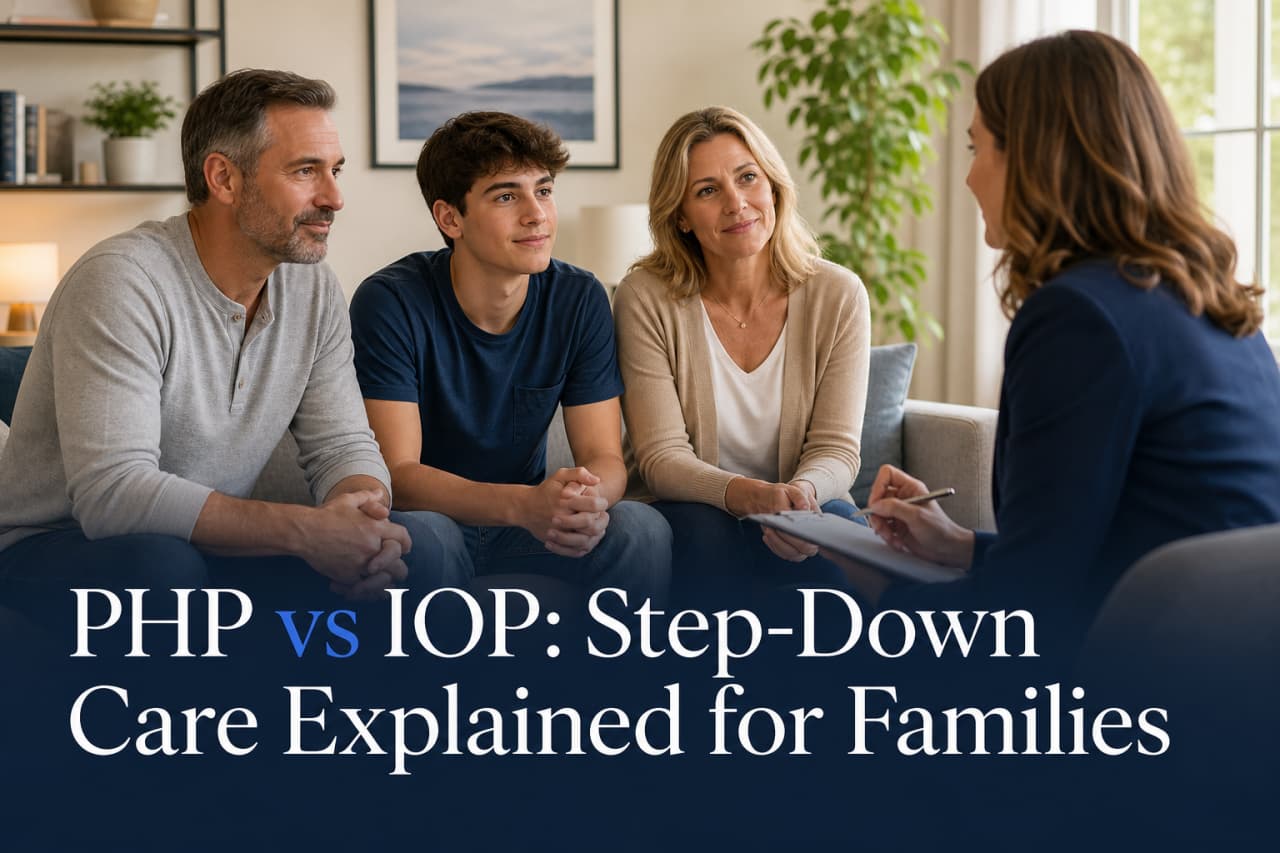
A partial hospitalization program delivers at least 20 hours of structured services a week under the ASAM Criteria, according to one program's summary of the standard, while adult intensive outpatient commonly starts at a minimum of 9 hours. That hours gap is the simplest way to frame PHP vs IOP, though it skips the parts families actually argue about on the phone. Faith Recovery Center in Beverly Hills offers both levels inside one continuum of care, and the choice comes down to how acute your symptoms still are, how much of your week you can give to treatment, and how much medical and psychiatric oversight you need.
PHP vs IOP: The Short Answer
PHP is the right call when you need near-daily structure and closer clinical contact but do not need to sleep at a treatment facility. IOP is the right call when you are stable enough to keep working or attending school and need structured support several days a week.
Neither level is better in the abstract. PHP suits someone whose symptoms still interrupt daily functioning or whose medications are still being adjusted, and IOP suits someone who can get through evenings and weekends safely and needs treatment built around existing responsibilities. The final call belongs to a clinical assessment rather than to anyone's preference, including ours.
Where PHP and IOP Fit in the Continuum of Care
The American Society of Addiction Medicine lays treatment out as a continuum of levels, from outpatient therapy up through medically managed inpatient care. In the ASAM Criteria, intensive outpatient is Level 2.1 and partial hospitalization is Level 2.5. Residential treatment sits above both at Level 3, and standard outpatient sits below at Level 1.
The numbering tells you PHP is one step up in intensity from IOP, not a different kind of treatment. Many people enter PHP after medical detox or residential care, then move to IOP, then to standard outpatient and aftercare. Others start directly in IOP because an assessment shows they can handle it. Clinical need sets the path at each point, and nobody is locked into a fixed sequence.
What Is a Partial Hospitalization Program (PHP)?
A partial hospitalization program is day treatment. You spend most of the day in structured clinical programming, then return home or to a sober living setting at night, and sleeping in your own bed is the main thing separating PHP from residential care.
PHP carries much of the clinical content of residential treatment, including individual therapy, group therapy, psychiatric follow-up, and medication management. One program describes PHP as including more frequent psychiatric monitoring, on-site nursing, and same-day crisis response compared with IOP. What you give up is the 24-hour environment, so PHP works when your home is safe and substance-free enough to go back to each evening.
Typical PHP Schedule and Time Commitment
A typical PHP schedule runs five days a week for about four to six hours a day, though some programs run longer days. That works out to roughly 20 or more hours weekly, which is effectively a full-time commitment. Most people pause work or school during PHP, and our admissions team can talk through medical leave documentation with you before you start.
What Is an Intensive Outpatient Program (IOP)?
An intensive outpatient program is structured treatment that fits around the rest of your life. You attend several sessions a week, usually three to five, and spend the remaining time at work, at school, or at home applying what you practiced in session.
IOP keeps the core therapy of the higher levels, especially group work and cognitive and dialectical behavioral therapy, in a lighter format. Programs use it both as an entry point for people with moderate symptoms and as a step-down after PHP or residential care, as one outpatient provider describes.
Typical IOP Schedule and How Long It Lasts
A common IOP schedule is about three hours a day, three to five days a week, which lands at roughly 9 to 15 hours weekly. Some programs offer evening tracks so you can hold a normal work schedule. Hours can shift over time as your diagnosis sharpens or your progress speeds up.
At Faith Recovery Center, outpatient programming often lasts one to three months or longer, with the schedule set by clinical need rather than a calendar. IOP works when you have stable housing, reliable transportation, and the ability to manage day-to-day responsibilities between sessions. If any of those pieces is missing, say so on the first call, because it may change the level of care your assessment recommends.
Key Differences Between PHP (ASAM 2.5) and IOP (ASAM 2.1) at a Glance: 7 Factors
The table below compares the two levels on seven factors that carry the most weight in a clinical decision. Ranges are typical figures drawn from published program descriptions and vary by provider and by person.
| Factor | PHP | IOP |
|---|
| ASAM level | 2.5 | 2.1 |
| Typical weekly hours | About 20 or more | About 9 to 15 |
| Days per week | Usually 5 | Usually 3 to 5 |
| Work or school | Usually paused | Usually continues |
| Medical and psychiatric contact | More frequent, often daily | Weekly or every other week |
| Typical length | Often 2 to 6 weeks, sometimes up to 12 | Often 6 to 12 weeks or longer |
| Best fit | Recent detox, unstable symptoms, medication changes | Stable symptoms, safe home, need for flexibility |
The hours gap exists for a clinical reason. One provider puts PHP weekly contact at roughly two to three times the hours of IOP, and that extra time matters when cravings are strong, mood is volatile, or withdrawal symptoms are still settling, because clinicians can catch problems early and you have fewer unstructured hours to fill alone. The length ranges in the table come from published program comparisons, and your own course may run shorter or longer.
Therapies and Services: Where the Levels Overlap and Diverge
Both levels draw on the same evidence-based approaches, including CBT, DBT, group therapy, relapse prevention, and family sessions. The difference is dose and oversight. One comparison lists daily psychiatric evaluations in PHP versus weekly or bi-weekly reviews in IOP, which is why PHP suits someone starting or adjusting medication for anxiety, depression, or opioid use disorder. IOP can include medication management as well, through scheduled check-ins rather than near-daily contact.
Who Is a Good Fit for PHP vs IOP
PHP tends to fit you if you just finished medical detox or residential treatment, if symptoms still make a normal day hard to get through, if you returned to use while in standard outpatient care, or if a co-occurring mental health condition needs close psychiatric attention. One program frames it as the level for acute symptoms, recent detox or hospitalization, or higher monitoring needs in someone who still does not need 24-hour supervision.
IOP tends to fit you if symptoms are stable, home is sober and steady, you are motivated to keep up with work or school, and withdrawal has not produced recent medical complications. One provider notes that people in high-conflict or unsupported home environments may do better in PHP, so be honest about what you are going home to each night.
Both levels treat substance use disorders and mental health conditions, often at the same time. Plenty of callers cannot tell which level they belong in before the first conversation, and sorting that out is the whole point of a clinical assessment.
PHP vs IOP Decision Framework: 7 Criteria and the 3-of-5 Rule
Clinicians weigh many factors when recommending a level of care. These seven are the ones families and prospective clients can think through before picking up the phone.
Withdrawal risk comes first. If withdrawal is still resolving, especially from alcohol or benzodiazepines, you need medical supervision before any outpatient level and closer oversight after it. Symptom severity is second, since frequent cravings, panic, or mood swings that interrupt a workday point toward PHP. Medication status is third, because starting or adjusting psychiatric medication or MAT favors the more frequent contact PHP provides. Home environment is fourth, since a household with substances present or ongoing conflict makes the fewer hours of IOP harder to sustain. Recent history is fifth, because a recent return to use or a recent residential discharge usually calls for PHP as a bridge. The last two are practical. If you cannot step away from work, school, or caregiving, IOP may be the realistic choice when it is clinically safe, and sober friends, involved family, and peer groups make it safer to spend more of the week outside treatment.
If three or more of the first five criteria describe you, open the conversation with PHP in mind. If most apply only mildly and your support system is solid, IOP is likely a reasonable place to begin.
Stepping Up or Down Between PHP and IOP
A PHP to IOP transition is a clinical decision you make with your treatment team, based on what they observe rather than a date on the calendar. The transitions that hold are warm handoffs, where the same clinicians who know your history stay involved as your schedule changes.
Stepping up works the same way in reverse. If you are in IOP and symptoms worsen, you can move back into PHP, and that move means the system caught a problem early rather than late.
Signs It May Be Time to Step Down or Step Up
Common readiness criteria for stepping down include consistent attendance for at least two weeks, stable scores on mood and substance-use measures, no recent crises, and coping skills used in real situations. Your team will also want to see steady sleep, medications that no longer need frequent adjustment, and a home environment that supports recovery.
Signs to step up include a return to use, cravings you cannot manage between sessions, missed sessions, worsening anxiety or depression, or thoughts of self-harm or trouble functioning day to day. If you or someone you love is in immediate danger, call or text 988 to reach the 988 Suicide and Crisis Lifeline, or call 911.
How Faith Recovery Center Delivers PHP and IOP
Our outpatient programs sit inside a full continuum at one licensed Beverly Hills facility, running from medical detox through residential treatment, PHP, IOP, outpatient care, and aftercare. That matters most at the transitions. When you step down to PHP after residential care, or make the PHP to IOP move later, you keep the same clinical team instead of retelling your history to strangers.
Medical and psychiatric care are built into every plan. Dr. Jason Giles, M.D., a board-certified physician, oversees medical protocols including detox and MAT, and Dr. Julio Meza, M.D., a licensed psychiatrist, handles dual diagnosis care for anxiety, depression, trauma, and bipolar disorder alongside addiction. We take a maximum of 8 patients at a time, so the clinicians reviewing your case know your history and goals without checking a chart.
Programming draws on CBT, DBT, EMDR, group therapy, family therapy, life skills education, and relapse prevention, with yoga, mindfulness, and art therapy available alongside clinical sessions for anyone who wants them. Faith Recovery Center is accredited by The Joint Commission, licensed by the California Department of Health Care Services under license 190130AP, and LegitScript certified. Our name refers to hope and renewal, and we are not a religious program. Spirituality enters your plan only if you ask for it.
Cost, PPO Insurance, and Length of Stay: Often 1 to 3 Months in Outpatient
PHP generally bills more per week than IOP, with or without insurance, because it includes more hours of clinical care and more frequent medical contact. Over a full episode of care, the total depends on how long you spend at each level, so the weekly figure alone does not predict what you will pay.
Addiction and mental health treatment are essential health benefits under the Affordable Care Act, as explained on HealthCare.gov. Many private plans cover both PHP and IOP, though coverage depends on the plan and on documented medical necessity, and a step down to IOP typically requires a separate authorization rather than an automatic continuation of the PHP approval. We work with many private PPO plans, including Aetna, Anthem, Blue Cross Blue Shield, Cigna, Optum, and UnitedHealthcare, and we verify your benefits free and confidentially before you commit to anything. Private pay options are also available.
Length of stay is individualized. PHP often lasts a few weeks, and our outpatient programming commonly runs one to three months or longer depending on clinical progress.
Questions to Ask a Provider Before Choosing PHP or IOP
A good program answers these clearly on the first call. Vague answers are a reason to keep looking.
Ask how many hours per week each level runs and whether evening options exist. Ask who provides psychiatric care and medication management, and how often you will actually sit across from that person. Find out whether your clinical team stays the same when you step down or step up, and how the program decides you are ready to move. Confirm the program is accredited and state licensed, and request the license number if the website does not show one. Finally, check whether the program verifies insurance and handles prior authorization, and how family members are brought into treatment.
Frequently Asked Questions About PHP and IOP
Is PHP better than IOP?
PHP is more intensive than IOP, and intensity is a separate question from quality. The right level is the one that matches your current symptoms and stability. Starting too light can raise the risk of returning to use, and starting too heavy can disrupt your life without adding clinical benefit.
Can you go directly into IOP without doing PHP first?
Yes. Many people start in IOP when an assessment shows stable symptoms, low withdrawal risk, and a sober home, and PHP is never a required first stop.
Do you have to do IOP after PHP?
It is not mandatory, but a PHP to IOP step-down is the most common and usually the safest path. Ending near-daily treatment with nothing scheduled afterward removes support at the exact moment everyday triggers come back into view.
Are PHP and IOP used for mental health as well as addiction?
Yes, both levels treat mental health conditions, substance use disorders, or both together. At Faith Recovery Center, dual diagnosis care is integrated so psychiatric treatment and addiction treatment happen inside the same plan with the same team.
What happens after completing an intensive outpatient program?
Most people move into standard outpatient therapy and aftercare, which can include ongoing individual therapy, peer support such as AA or SMART Recovery, and a written relapse prevention plan. We coordinate aftercare before discharge so there is no gap between levels.
Do PHP programs offer medication management that IOP programs do not?
Both can include medication management, but PHP usually offers more frequent physician and psychiatric contact. That is why PHP is often recommended while medications are being started or adjusted.
If you are weighing PHP vs IOP for yourself or someone you love, a short confidential call is the fastest route to a clear answer. Our admissions team is available 24/7 at (844) 598-5573, no doctor's referral is needed, and family members can call on someone's behalf.
“TIP: Speak with admissions at (844) 598-5573 or visit /contact/ to verify your insurance for free.”