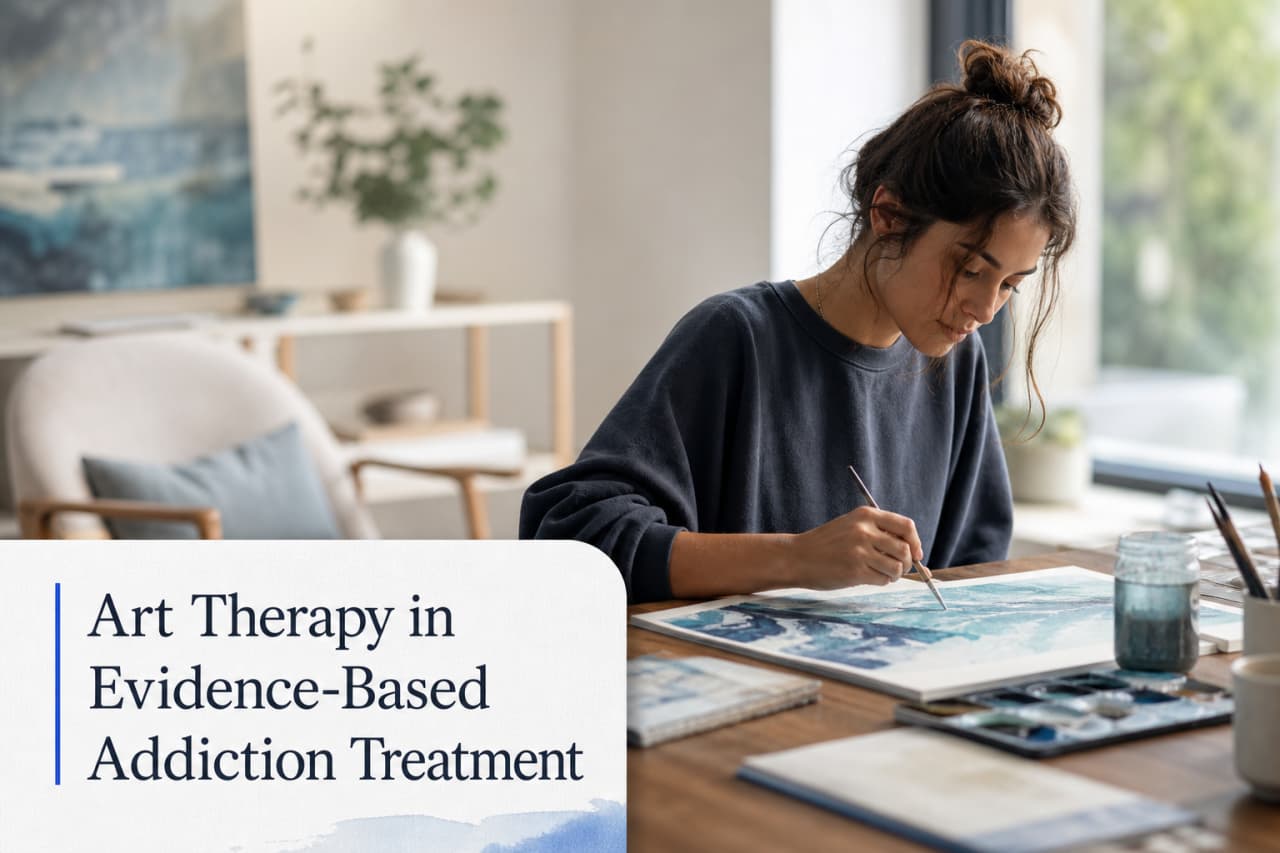
At Faith Recovery Center, a private Beverly Hills treatment center that admits a maximum of 8 patients at a time, art therapy is offered alongside CBT, DBT, EMDR and medical care. The premise is that making something can express what you can't yet say out loud. It complements those other treatments rather than replacing them, and you don't need any artistic skill to take part.
What Is Art Therapy for Addiction Treatment?
Art therapy uses art-making to help people express themselves and explore their emotions, based on the belief that the creative process can be healing (UKAT). A trained therapist guides you through making images or objects, then helps you make sense of what came up. The finished piece matters less than what you notice while making it and what you say about it afterward.
That separates it from an art class or a recreational craft hour. The focus is on expression and emotion rather than the technical side of art (Recovery Lighthouse). A therapy session also has a clinical goal, a therapist watching how you respond to the materials, and a conversation that connects the work to your recovery.
Why Art Therapy Works in Addiction Recovery
Research on art therapy for substance use disorder is still developing, and no one can promise a particular outcome or a lower rate of returning to use. What clinicians describe are reported benefits and plausible mechanisms. One review proposes that art's novel sensory experiences may stimulate dopamine release tied to natural, goal-directed rewards that involve no chemicals (PMC review), though that remains a proposal. Experience also varies from person to person, which is why our team, working with no more than 8 patients at a time, can adjust the work to each person.
Emotional Expression and Healing
Many people entering addiction treatment have used substances to mute emotions they never learned to name. Mayo Clinic notes that drug use can become a way of coping with painful feelings such as anxiety, depression and loneliness (Mayo Clinic). Words can fail here, especially with trauma, and imagery can reach memories that talk therapy circles around because an image doesn't require a tidy narrative. Trauma and substance use frequently occur together, which is one reason our team builds trauma-informed care into treatment plans, with Dr. Julio Meza, our psychiatrist, treating co-occurring conditions alongside addiction.
Self-Esteem, Self-Awareness and Relapse Prevention
Finishing a piece, even a rough one, gives you evidence that you can start and complete something, which can rebuild self-esteem that years of use eroded. Patterns also show up on the page, such as the colors you avoid or the way stress changes your pace. One treatment provider describes art therapy as supporting relapse prevention by developing coping skills and resilience (New Choices). That is a third-party claim rather than a proven result, and art therapy alone isn't established to prevent a return to use.
Types of Art Therapy Techniques
Visual Arts: Drawing, Painting and Collage
Drawing, painting and collage are the most common visual arts approaches. Collage is a gentle starting point because you cut images from magazines and arrange them, so there's no blank page to fear. Mandala designs, circular patterns you color or draw, are often used to settle stress and anxiety before heavier work.
Therapists also use named methods. The Gestalt method asks you to create a piece of artwork and then verbalize the thoughts and feelings behind it (Recovery Lighthouse). Active imagination gives you freedom to paint or draw whatever arises, and the therapist asks questions that link the artwork back to your emotions. In the third-hand method, the therapist creates a drawing or painting based on your instructions, which lets you voice your thoughts indirectly and can help if you feel stuck.
Expressive Writing and Movement-Based Expression
Some people find paper easier than canvas. Expressive writing and movement-based expression give you other routes for thoughts and feelings, and they sit comfortably beside the yoga and mindfulness practices in our programming.
How an Art Therapy Session Works
Sessions follow a rough sequence, and the therapist observes what you create and asks questions designed to connect the artwork with your thoughts and emotions (UKAT). The therapist first sets a focus, such as a feeling, a trigger or a goal for the week, and shows you the materials. You then create for a set period, usually without a required outcome. Afterward you look at the work together, describing what you see and what it stirred up. The session closes by linking those observations to your treatment plan, so insights reach your individual and group therapy sessions.
Art Therapy Prompts to Try in Recovery
If you want to experiment between sessions, keep prompts simple. You might draw your cravings as a shape or weather pattern, or make a collage of what a good Tuesday looks like a year from now. Another option is to color a mandala while noticing where stress sits in your body, or to sketch a place where you feel calm and would want to return. Stop if anything becomes distressing and bring it to your therapist.
Who Can Benefit From Art Therapy
Art therapy can be used at any stage of treatment, from detox and withdrawal through aftercare (UKAT). At our center that spans medical detox, residential care, PHP, IOP and aftercare. It's especially useful if you're guarded in talk therapy, carry trauma, or find your challenges hard to describe. A review of 253 inpatients with substance use disorders found 80% had at least one traumatic event (PMC review). Skill is irrelevant, and people who say they can't draw often do their most revealing work with stick figures and scribbles.
Art Therapy at Faith Recovery Center
Art therapy and yoga are part of the whole-person programming at our Beverly Hills estate, delivered alongside evidence-based care including CBT, DBT and EMDR. Because we treat no more than 8 patients at a time, your clinicians know you by name and can match creative work to your treatment plan. Medical detox, residential treatment, medication-assisted treatment and step-down outpatient care happen under one roof, so art therapy can continue as your level of care changes. Length of stay is individualized, and residential typically runs 30 to 90 days.
Clinical oversight comes from licensed professionals. Dr. Jason Giles, M.D., a board-certified physician, oversees medical protocols from detox assessment through residential care, and Dr. Julio Meza, M.D., integrates psychiatric care with addiction treatment. Faith Recovery Center is licensed by the California Department of Health Care Services (license 190130AP) and accredited by The Joint Commission. Art therapy works alongside 12-step participation and MAT, since it addresses emotional processing rather than replacing either.
How to Evaluate an Art Therapy Program
Start by asking who leads the sessions, because a credentialed clinician such as a board-certified art therapist is different from an activity coordinator. Ask whether the work is tied to your treatment plan and discussed with your wider team, and whether the center treats co-occurring mental health conditions with a psychiatrist on staff. Check that the facility is licensed and accredited, and confirm that materials are varied enough to fit different comfort levels and that you can decline a prompt without penalty.
Is Art Therapy Right for You?
It's a strong fit if words feel inadequate, if trauma sits underneath your use, or if you've found traditional talk therapy flat. Some people simply prefer other approaches, and that is a legitimate preference. It's a weaker fit as your only treatment, and it isn't meant to be one. A clinical assessment will tell you where it belongs in your plan, and you can start that conversation without any commitment.
Continuing Creative Recovery After Rehab
Creative habits can outlast a program. Many people keep a journal, a sketchbook or a weekly collage session as a way to process stress without substances. Our aftercare coordination and relapse-prevention planning are part of discharge, and outpatient care can include continued creative work where clinically appropriate.
Frequently Asked Questions
How long does it take to see results from art therapy?
There's no fixed timeline. Some people feel relief or new insight within a few sessions, while others need longer to trust the process. Progress depends on your history and the rest of your plan.
Is there scientific evidence that art therapy reduces relapse?
Research is still growing, and we can't claim it lowers rates of returning to use. Clinicians value it as a complement that builds emotional awareness and coping skills within a broader plan.
Do I need artistic talent?
No. Successful art therapy might not even look good to anyone, because its success lies in expression rather than beauty (Eagle Crest Recovery). The therapist is interested in your process, not your technique, and nobody grades the work.
How do I find a credentialed art therapist?
Ask any program who leads the sessions and what credentials they hold. The American Art Therapy Association and the Art Therapy Credentials Board list professional standards and credentials. SAMHSA's treatment locator can also help you compare programs.
Does insurance cover art therapy for addiction?
Art therapy is typically delivered as part of a treatment program rather than billed on its own. Coverage depends on your plan and level of care. We offer free, confidential insurance verification and work with many major PPO plans.
Talk With Our Admissions Team
Call Faith Recovery Center admissions at (844) 598-5573, any hour, to talk through care options and verify your insurance. Calls are confidential and carry no obligation.